Tropical Cyclone Olwyn
Tropical Cyclone Olwyn made landfall on the North West coast of Western Australia while two other Tropical Cyclones were active in the Australian and adjoining regions. Tropical Cyclone Nathan brushed the North Queensland coast and Tropical Cyclone "Pam" developed into a category 5 Severe Tropical Cyclone and traveled South over Vanuatu in the South Pacific ocean.
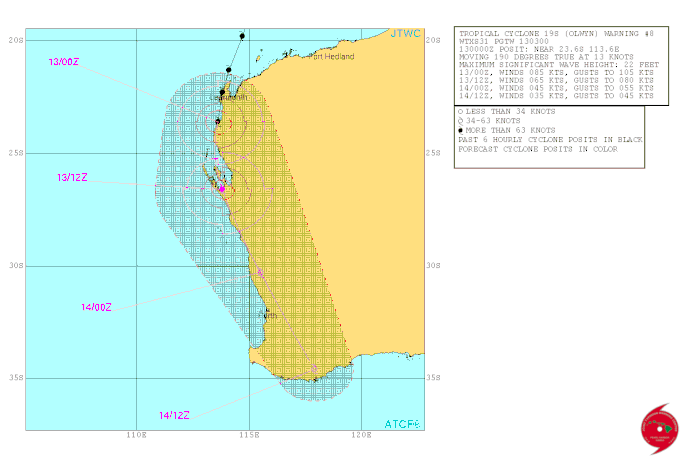
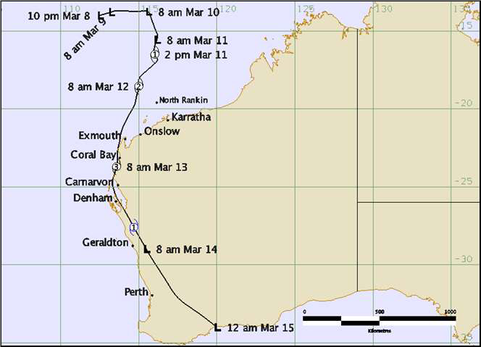
Severe Tropical Cyclone Olwyn was the most significant tropical cyclone to affect the Gascoyne coast in decades, tracking close to the coast from Exmouth to Shark Bay as a category three tropical cyclone. Olwyn began as a tropical low in an active monsoon trough approximately 900 kilometres (km) north of Exmouth during 8 March 2015. The tropical low initially moved slowly towards the east before moving towards the south on 10 March. It then maintained a southerly track while slowly strengthening. The topical low reached tropical cyclone intensity at 0600 UTC (1400 WST) 11 March. Olwyn then moved towards the south southwest and passed just to the west of Exmouth around 1800 UTC 12 March. The tropical cyclone reached a peak intensity of 75 knots (kn) (139 kilometres per hour (km/h)) at 1800 UTC 12 March while it was located near the North West Cape. Learmonth Airport reported a 10-minute mean wind of 75 kn (139 km/hr) and a maximum 3-second wind gust of 97 knots (180 km/hr) during this period.
Olwyn continued a southerly path straddling the upper west coast. The tropical cyclone centre passed just to the west of Coral Bay and then passed around 25 kilometres (km) to the west of Carnarvon around 0600 UTC 13 March. Carnarvon Airport reported a 10-minute mean wind of 55 knots (102 km/hr) and a maximum 3-second wind gust of 79 knots (146 km/hr) during this period. Olwyn was then steered in a south southeast direction and crossed the coast over the Shark Bay area around 1200 UTC 13 March. Olwyn weakened below tropical cyclone strength by 0000 UTC 14 March, inland of Geraldton.
Heavy rainfall was recorded over the western Pilbara and western Gascoyne districts. The heavy rainfall was mostly concentrated near the coast and caused localised flooding and road closures in the western Pilbara and western Gascoyne districts. Widespread catchment rainfall of approximately 60 – 90 millimetres (mm) resulted in minor to moderate flooding within the Greenough and Irwin River catchments.
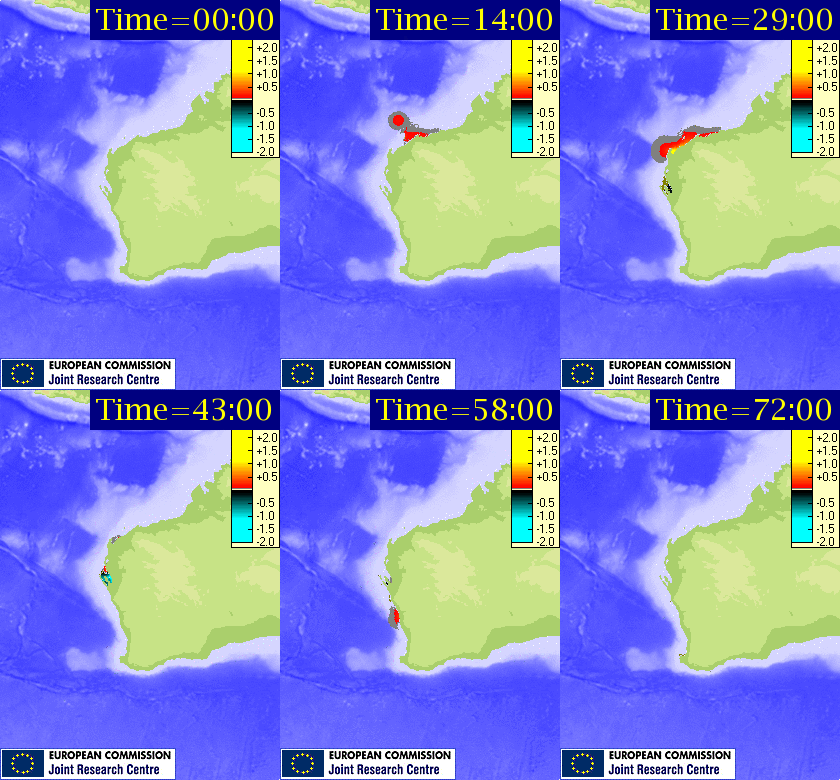
A storm surge of about 1.8 metres was recorded at Exmouth and about 0.7 metres at Carnarvon.
Minor to moderate damage to homes and infrastructure were reported and significant damage to plantations.
From www.bom.gov.au

Severe Tropical Cyclone Olwyn of North West Australia makes landfall as a Category 3
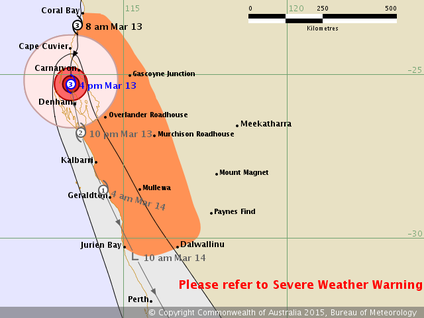
On 8 March 2015 a weak tropical low formed over Western Australia. Due to an increase in convection, the system was upgraded to a category 1 tropical cyclone and named Olwyn on 11 March. Just before 12 March, Olwyn rapidly developed a ragged eye, and upgraded to a category 3 severe tropical cyclone. Early on 13 March, Olwyn reached its peak strength as the JTWC classified it as a Category 2 cyclone. However, JTWC downgraded it to a Category 1 cyclone after a few hours. Late on the same day, Olwyn made landfall over southwestern Australia. Olwyn caused extensive damage along the coast of Western Australia, from Onslow to Kalbarri.
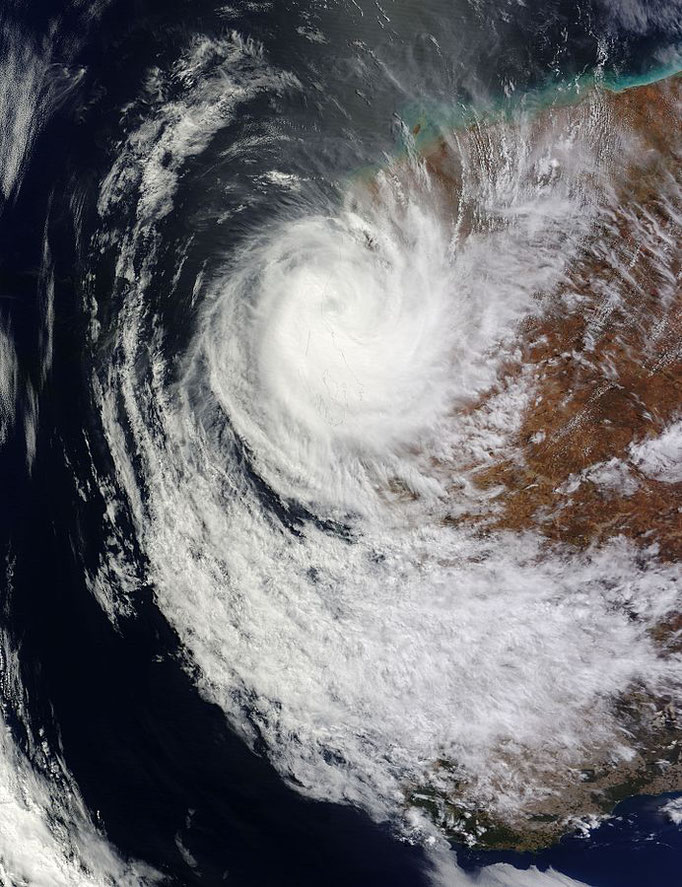
Satellite images